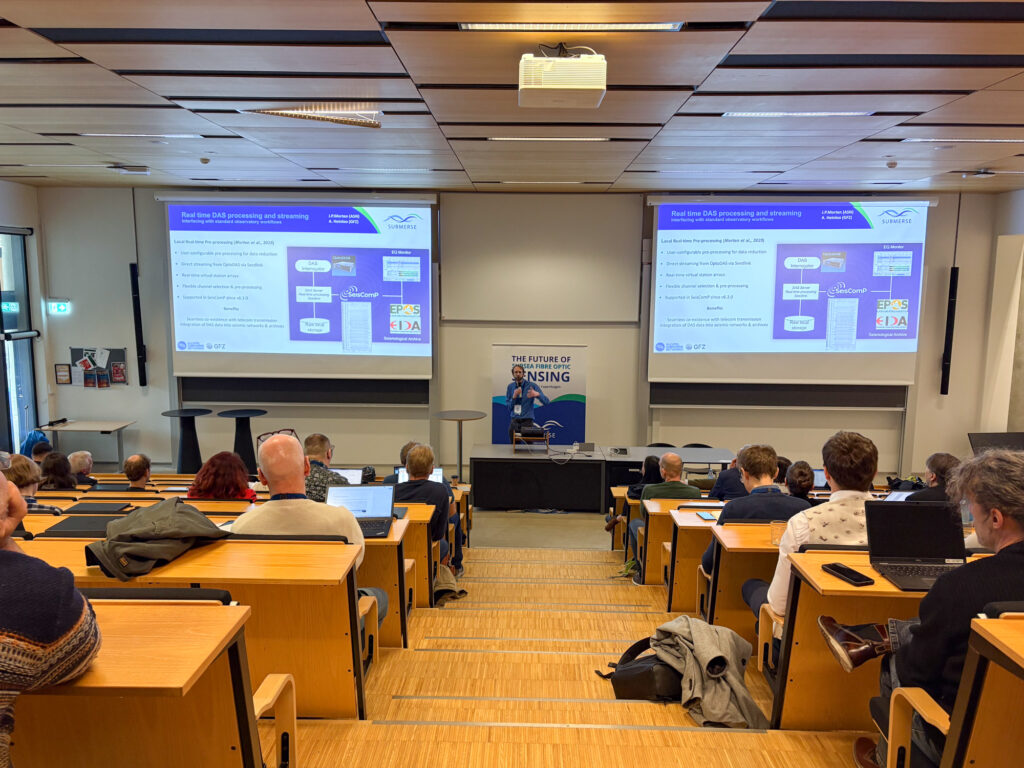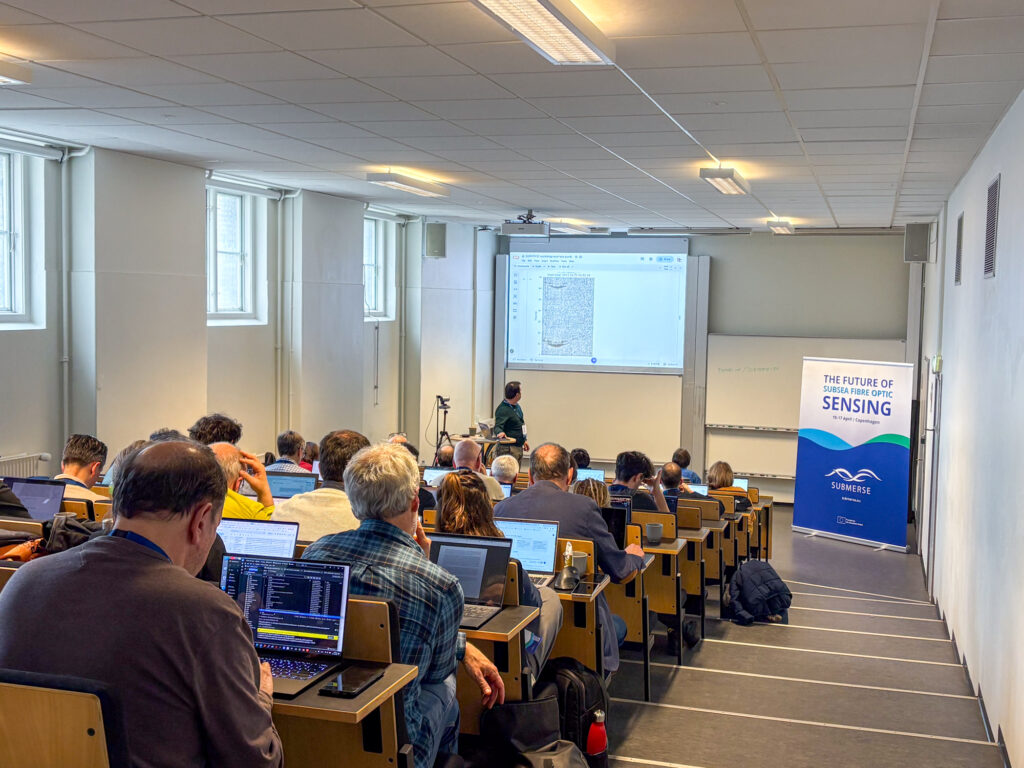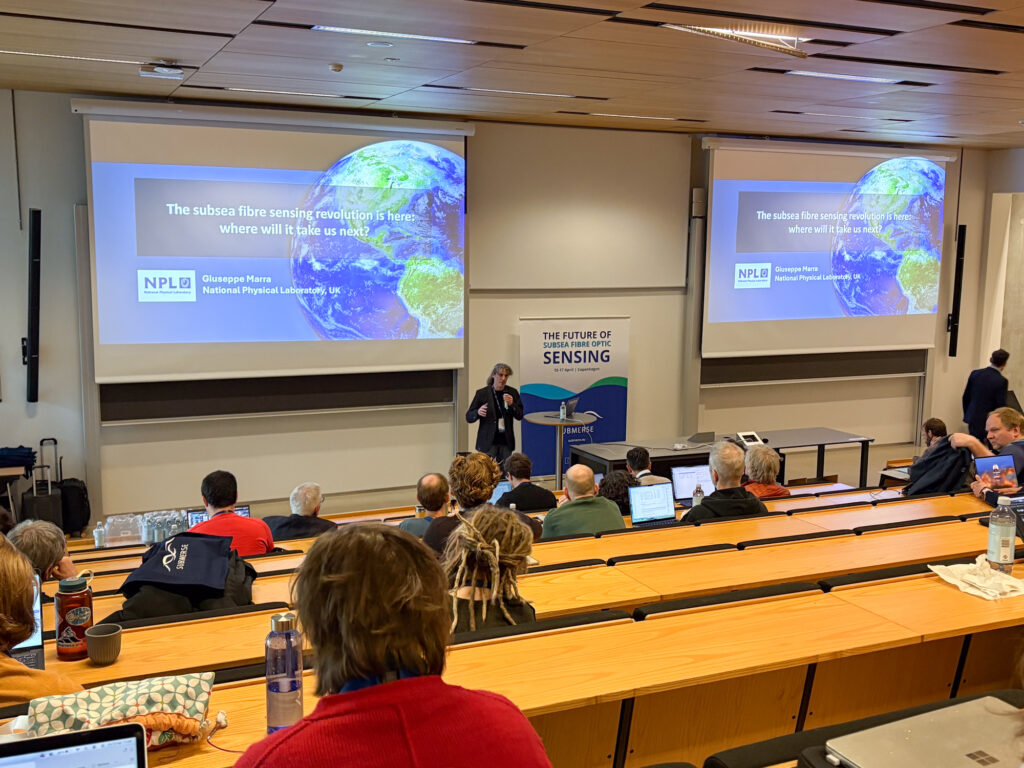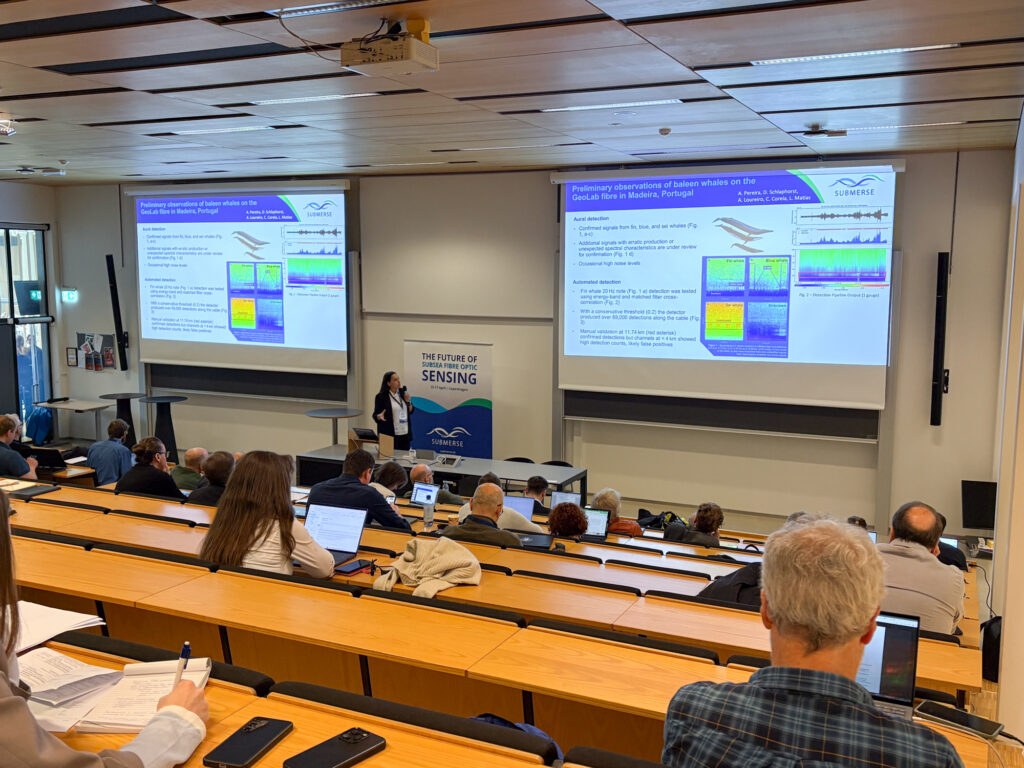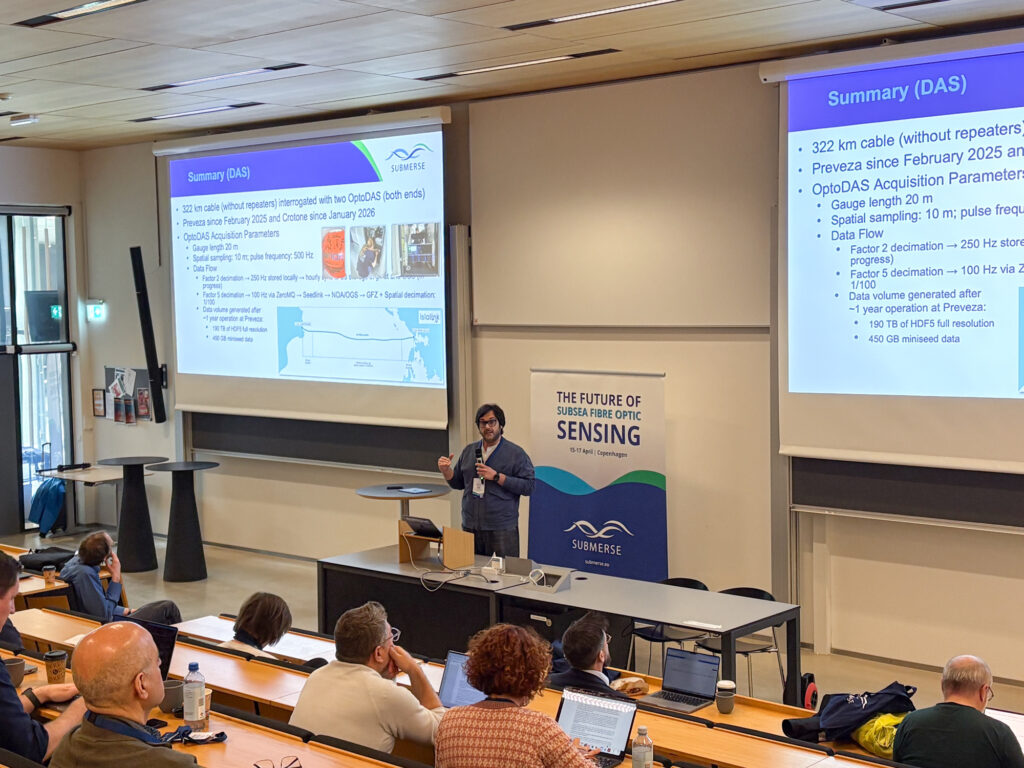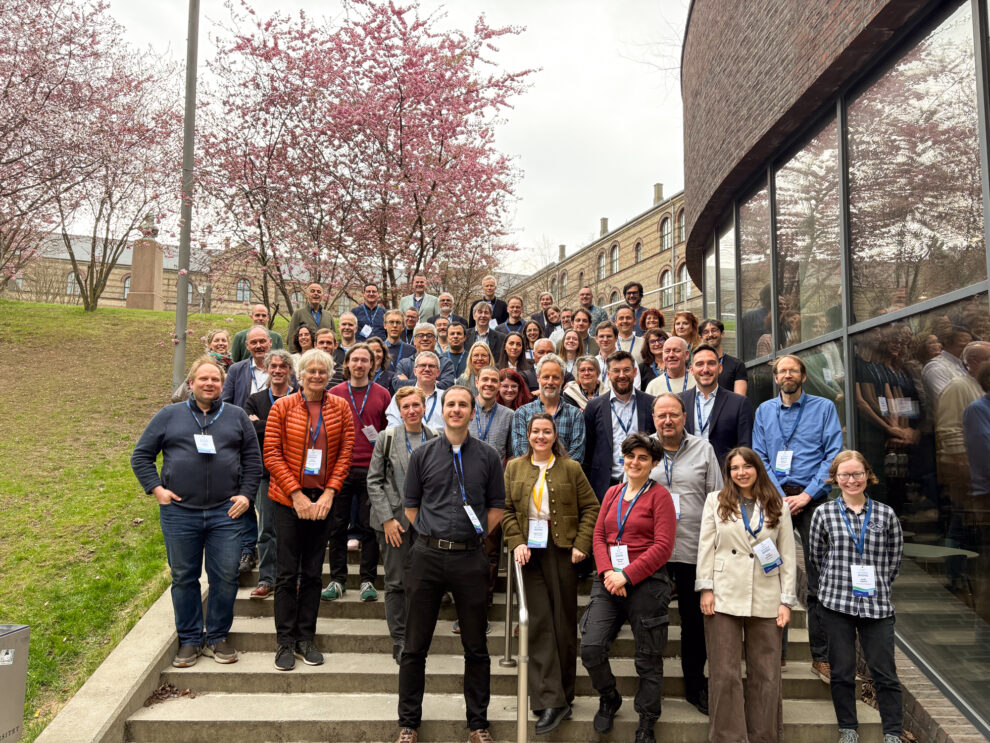
On 15–17 April 2026, the SUBMERSE project held its final event at the University of Copenhagen, Denmark. Over two and a half days, consortium partners, researchers, infrastructure operators, and industry representative gathered to share project results, reflect on three years of work, and discuss the future of fibre sensing in Europe.
The event was structured around three distinct days: a community day focused on science and hands-on training, a project results day covering the full scope of SUBMERSE’s achievements, and a closing day dedicated to future directions and collaboration.
Day 1: Community event
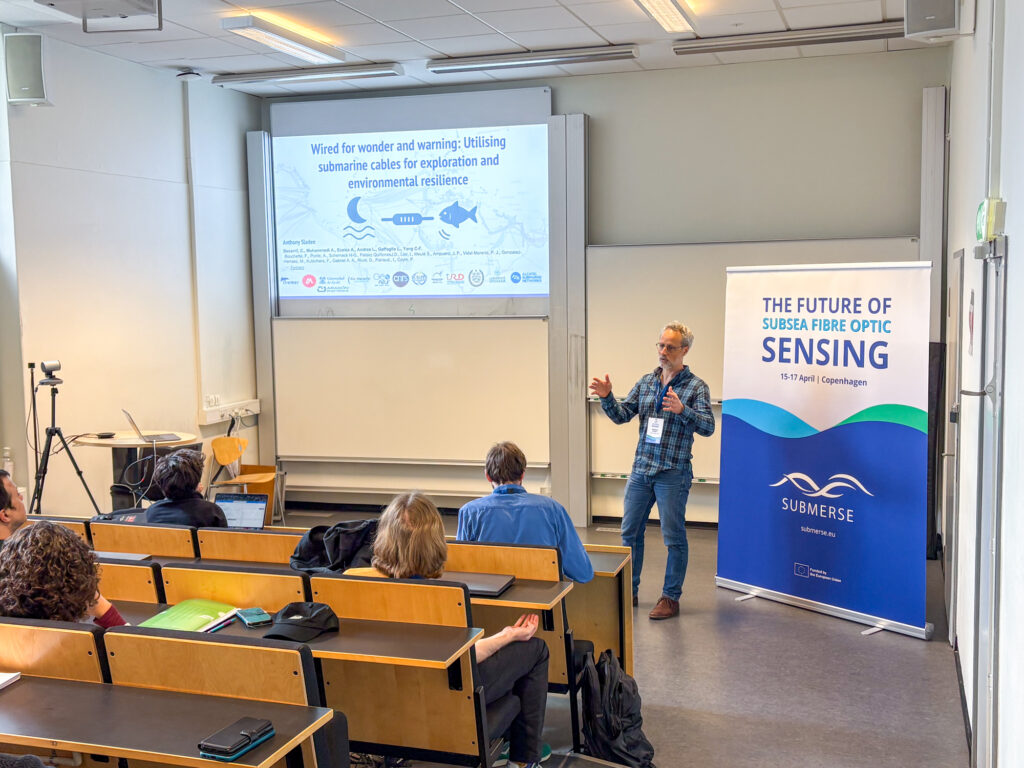
The first day opened with welcome remarks from Frederik Tilmann (GFZ Helmholtz Centre for Geosciences), Eleonora Parisi (LifeWatch ERIC), and René Belsø (DeiC), who framed the event as both a scientific milestone and a community celebration.
The opening keynote was delivered by Anthony Sladen, a CNRS geophysicist at Géoazur, whose research focuses on developing fibre-optic sensing to listen to the ocean floor. His talk “Wired for wonder and warning: utilising submarine cables for exploration and environmental resilience” presented a vision of what submarine cables can become when repurposed as scientific instruments.
The afternoon focused on hands-on training across two of SUBMERSE’s core scientific domains. The geoscience applications session, led by Afonso Loureiro (ARDITI) and covering work carried out with David Schlaphorst and Andrea Pereira, introduced participants to DAS-based seismic monitoring and its implications for earthquake and tsunami detection. The oceanographic applications session, led by Athanasia Papapostolou and Aggeliki Barberopoulou (Hellenic Centre for Marine Research), covered ocean wave activity and the broader implications for climate research.
Day 2: Project results
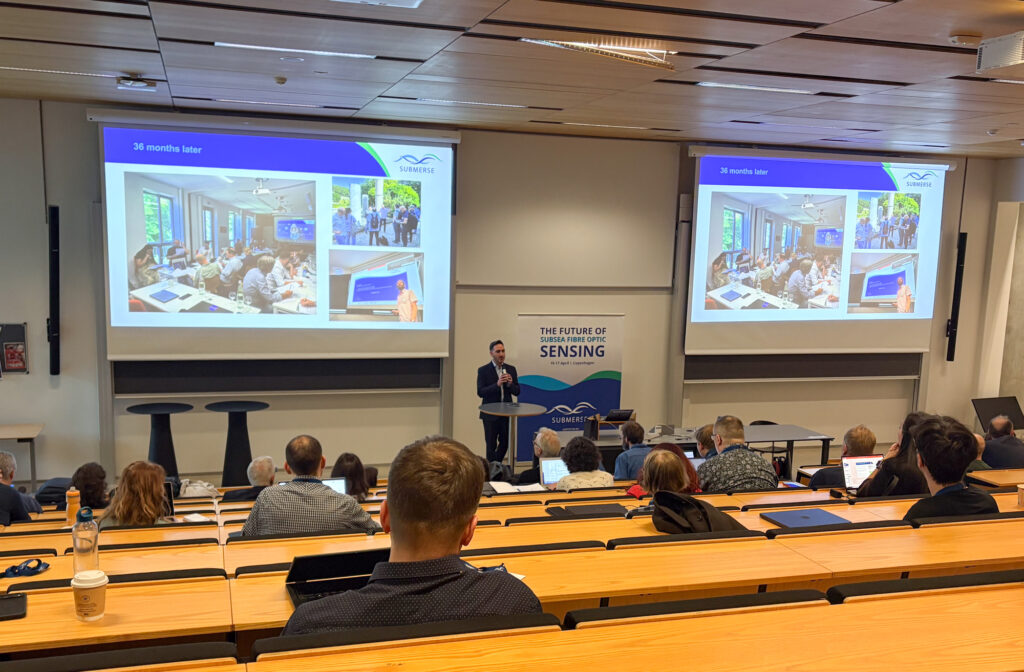
The second day was the formal core of the event, opening with remarks from Matías Barberis (EFIS Centre) and Chris Atherton (GÉANT).
Two keynotes framed the day from complementary perspectives. Sander Isendoorn (Netherlands Ministry of Interior and Kingdom Relations) addressed the security dimension of fibre sensing in his talk “When data changes meaning: ocean science in a security context.” With over 25 years in the security community and a decade focused on submarine telecommunications cables and critical underwater infrastructure, including work with NATO, ICPC, and ITU working groups, he explored how sensing data that can detect seismic activity and marine life can also enter sensitive territory when it comes to detecting ships and other maritime traffic.
Angeliki Xenaki, Principal Scientist at the Institute of Applied and Computational Mathematics (IACM-FORTH), followed with an outlook on fibre sensing applications, drawing on her expertise in signal processing, statistical modelling, and machine learning applied to acoustics and ocean monitoring.
Chris Atherton and Frederik Tilmann then presented an overview of SUBMERSE’s core results: three years of multi-site, multi-technology deployment across Norway, Portugal, Greece, and Italy.
The afternoon session on SUBMERSE use cases brought together presentations from Afonso Loureiro, Susana Silva, Angelo Strollo, Martin Landrø, and Luca Possenti, covering the full range of geoscience and environmental applications developed across the project. René Belsø and Hannah Mihai (DeiC) presented the project’s data management strategy, addressing one of the most critical challenges for scaling fibre sensing across Europe: how to handle sensitive raw data while enabling open, FAIR-compliant scientific outputs.
An invited presentation from Aurelien Mordret (GEUS) shared two years of DAS acquisition experience from Denmark, offering practical lessons for the wider community.
The day closed with a series of Lightning Talks showcasing the breadth of research emerging from the fibre sensing field:
- Rudolf Vohnout (CESNET) on bidirectional channel sensing
- Menno Buisman (NTNU) on ultra-long DAS measurements up to 200 km
- Miquel Masanas (Nokia-Coriant) on SOP-OTDR processing on the EllaLink Sines–Fortaleza cable
- Nicolas Celli (DIAS) on long telecom fibres as geosensors through the IMAGFib project
- Peter Gerstoft (TUD) on machine learning and signal processing for DAS
Day 3: Future directions
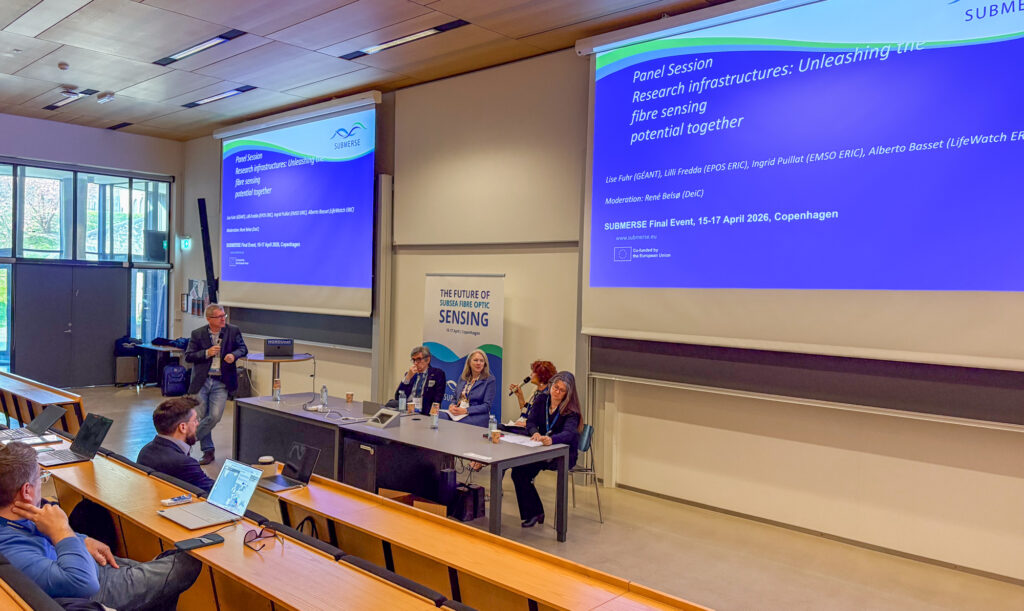
The final day opened with a session on future research directions in seismology, oceanography, and marine biology, led by Frederik Tilmann, Martin Landrø, and Athanasia Papapostolou.
The central part of the day was the panel session, “Research infrastructures: unleashing the fibre sensing potential together,” moderated by René Belsø. The panel brought together the leaders of four major European research infrastructures: Lise Fuhr (GÉANT), Lilli Freda (EPOS ERIC), Ingrid Puillat (EMSO ERIC), and Alberto Basset (LifeWatch ERIC), to discuss how fibre sensing can move from proof of concept to an integrated, pan-European capability.
Several themes emerged from the discussion. Panelists emphasised that fibre sensing is not intended to replace existing monitoring technologies but to complement them, particularly in deep ocean environments where data remains scarce. The conversation repeatedly returned to the importance of collaboration across research infrastructures, and to the need for shared data governance frameworks that can work across national boundaries. The panel concluded that the next step is clear: establish the sites, produce the results, and build a common framework for moving forward together.
The closing keynote was delivered by Giuseppe Marra, Principal Scientist at the National Physical Laboratory (NPL), who has been pioneering interferometric techniques over terrestrial and submarine cables for the detection of earthquakes and environmental signals. His talk reflected on the scientific possibilities still ahead for submarine cable sensing and the work that remains to fully realise them.
Closing remarks from Matías Barberis, Frederik Tilmann, and Chris Atherton brought the event to a close, with thanks to every consortium partner and individual who contributed over the past three years. Their closing message to the community: keep the spirit of scientific adventure.
Why this matters
The SUBMERSE Final Event demonstrated that the project’s core ambition — repurposing existing submarine fibre-optic cables as permanent, real-time scientific instruments — has been realised across seven deployment sites in five countries. The results span seismology, oceanography, and marine biology, and the data management frameworks developed by the consortium provide a foundation for scaling this work across Europe.
As the project concludes, the conversations it has started continue. The challenge now is to build on what SUBMERSE has proven, integrating fibre sensing into the European research infrastructure landscape and ensuring that the data it generates can be accessed, shared, and used for the benefit of science and society.
Alongside the Final Event, the SUBMERSE project has also published its Policy Brief, Opportunities and policy perspectives of subsea fibre-sensing technology, setting out concrete recommendations for EU policymakers on how to unlock the full potential of this infrastructure. Read the full article and download the Policy Brief here.
A few more photos from the event