

The SUBMERSE Consortium and all its 25 partners are excited to invite you to the SUBMERSE Project final event.
Over the past three years, we’ve been working together to explore how Europe’s submarine fibre-optic cables can become scientific tools for seismology, oceanography, and marine biology. Now, as the project enters its final phase, we’re bringing our community together in Copenhagen to share what we’ve learned, reflect on the journey so far, and look ahead to what comes next for fibre sensing in Europe.
Together with our partners from research institutions, industry, and the National Research and Education Networks (NRENs), we’ll explore project results, participate in training sessions, and discuss future research directions.
Practical information
Venue
- University of Copenhagen, Faculty of Social Sciences
- Full address: Gammeltoftsgade 15; DK-1355 Copenhagen, Denmark (closest train/metro station: Nørreport Station)
- The event will take place in various buildings and rooms throughout the 2,5 days. Please see the full programme and the campus map for detailed information
What to expect
Day 1 – 15 April 2026 – Community event
The community event will largely focus on scientific applications. We’ll hear an exciting keynote on geoscience and oceanographic use cases and participate in hands-on training sessions to work with fibre-sensing data.
Day 2 – 16 April 2026 – Project results
This day will be all about sharing what we’ve achieved across Europe. We’ll hear updates from all SUBMERSE fibre-sensing sites in Norway, Portugal, Greece, and Italy, explore our data management strategies, and take time to connect with partners and peers.
Day 3 – 17 April 2026 – Closing
On the final day, we’ll look ahead together. An engaging closing keynote will set the scene, followed by sessions exploring future research directions and opportunities for continued collaboration.
Keynote speakers
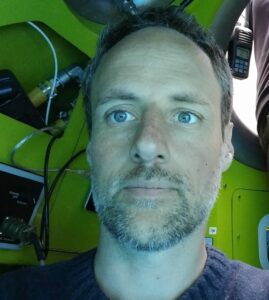 Wired for wonder and warning: Utilising submarine cables for exploration and environmental resilience
Anthony Sladen — Géoazur, France
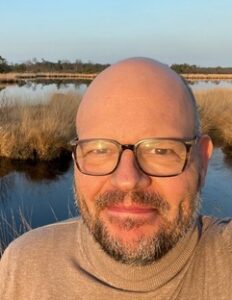
When data changes meaning: Ocean science in a security context
Sander Isendoorn — Netherlands Ministry of Interior and Kingdom Relations
Sander Isendoorn has been active in the security community for over 25 years. For the past 15 years he has had a special interest in internet topology — first from a cyber perspective, and over the last decade increasingly focused on physical infrastructure, particularly submarine telecommunications cables and critical underwater infrastructure. He is currently involved with NATO, ICPC, and ITU working groups on topics including cable resilience and cable sensing.
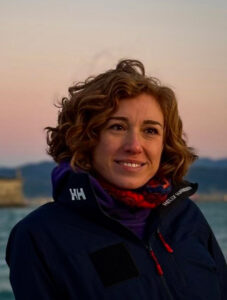
Outlook on fibre sensing applications
Dr. Angeliki Xenaki — Institute of Applied and Computational Mathematics (IACM-FORTH)
Angeliki Xenaki received her Diploma in Electrical Engineering and Computer Science from the National Technical University of Athens (NTUA), and her M.Sc. and Ph.D. in Acoustics from the Technical University of Denmark (DTU). She has held research positions at Scripps Institution of Oceanography (University of California at San Diego (UCSD)), DTU, GN Hearing A/S (Denmark), and the Centre for Maritime Research and Experimentation (STO-NATO, CMRE, Italy). In 2025, she joined the Foundation for Research and Technology-Hellas as a Principal Scientist, where her research focuses on signal processing, statistical modelling, and machine learning applied to acoustics and sonar imaging.
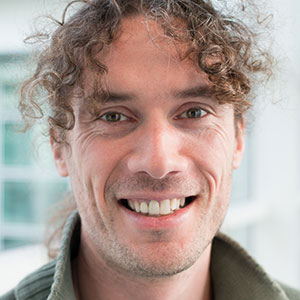 The subsea fibre sensing revolution is here: Where will it take us next?
Giuseppe Marra — The National Physical Laboratory (NPL)
Giuseppe Marra is a Principal Scientist in the Time and Frequency department at the National Physical Laboratory, where he has worked since 2002. His research focuses on optical frequency metrology, including the dissemination of ultra-stable optical frequencies over fibre links and the comparison of optical atomic clocks over intercontinental distances. Over the last several years, he has been pioneering ultra-stable interferometric techniques over terrestrial and submarine cables for the detection of earthquakes and other environmental signals — work that points to new possibilities for monitoring the largely under-sampled ocean floor.
Meet the panelists: Research infrastructures — Unleashing the fibre sensing potential together
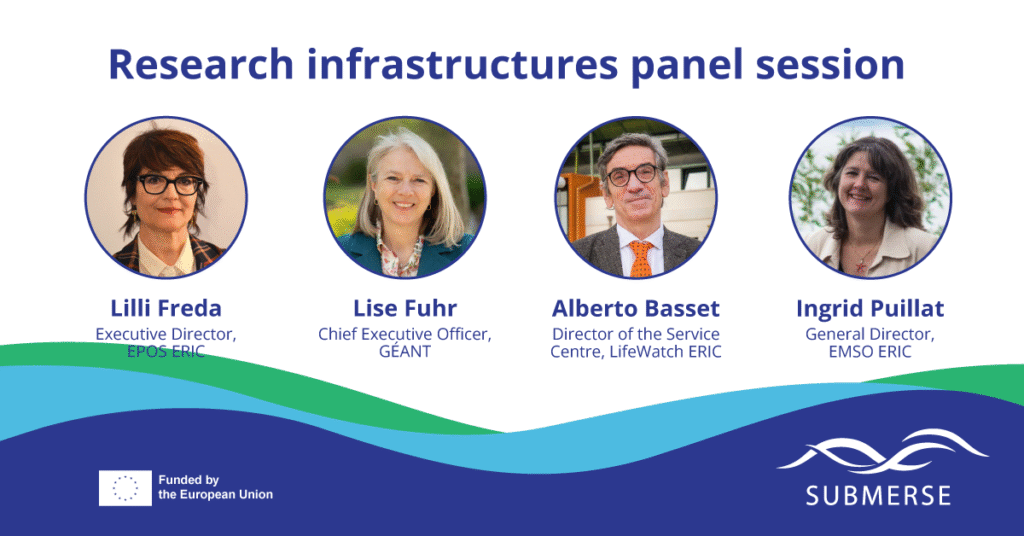
Over the past three years, SUBMERSE has demonstrated what submarine fibre-optic cables can do as scientific instruments. The question now is: what comes next, and how do we get there together? This panel on Friday, 17 April brings together the leaders of four major European research infrastructures to explore how fibre sensing can move from proof-of-concept to an orchestrated, integrated capability across disciplines. The discussion will focus on the willingness to progress collectively, the organisational structures needed to advance fibre sensing, and the scientific and societal impact that a shared infrastructure vision could unlock — from dispersed data collection to higher-level data products serving multiple European ESFRI and ERIC communities.
Lilli Freda — Executive Director, EPOS ERIC
Lilli Freda has been a researcher at INGV (Italian Institute of Geophysics and Volcanology) since 2001, after beginning her career in 1990 at the University of Rome “La Sapienza” and the National Research Council. Since 2012, she has held several key roles within EPOS, including Scientific Officer, Coordinator of the Sustainability Phase, Director of the Implementation Phase, and member of major governance bodies. Combining scientific expertise with management experience, she has developed strong knowledge in operating large-scale research infrastructures and in European solid Earth science policy, working closely with international partners, governments, and institutions.
Lise Fuhr — CEO, GÉANT
Lise Fuhr is the CEO of GÉANT, Europe’s leading collaboration for advanced data networks and e-infrastructure in research and education. Lise brings over 20 years of experience in the internet, technology, and telecoms industries, having previously served as Director General of ETNO, the Brussels-based association representing Europe’s leading telecom operators. She has held senior roles across internet governance, cybersecurity, and digital policy, and is Chair of Security Tech Space, a member of the UN Internet Governance Forum Leadership Panel, and a lifelong member of ATV — the Danish Academy of Technical Sciences.
Alberto Basset — Director of the Service Centre, LifeWatch ERIC
Alberto Basset is full Professor of Ecology at the University of Salento (Italy), and Director of the Service Centre of LifeWatch ERIC, the e-Science European Infrastructure for Biodiversity and Ecosystem research. His main research interests include biodiversity organisation and maintenance, ecosystem functioning and services and their responses to natural and anthropic pressures, including climate change. Professor Basset is also part of the Advisory Committee of the European Research Infrastructure on ‘Multidisciplinary Seafloor and water column Observatory (EMSO ERIC).
Ingrid Puillat — Director General, EMSO ERIC
Ingrid Puillat is Director General of EMSO ERIC, the European Multidisciplinary Seafloor and water column Observatory. She holds a PhD in Physical Oceanography from the University of Aix-Marseille and brings more than twenty years of international experience in marine research institutions, including three years at the Directorate-General Joint Research Centre of the European Commission. She has played a key role in advancing European marine research infrastructures, contributing to the scientific coordination of ESONET-NoE and serving as Scientific Coordinator of the JERICO series of projects, which focused on building joint European research infrastructure networks for coastal observatories.
We are looking forward to welcoming you at our final project event!