

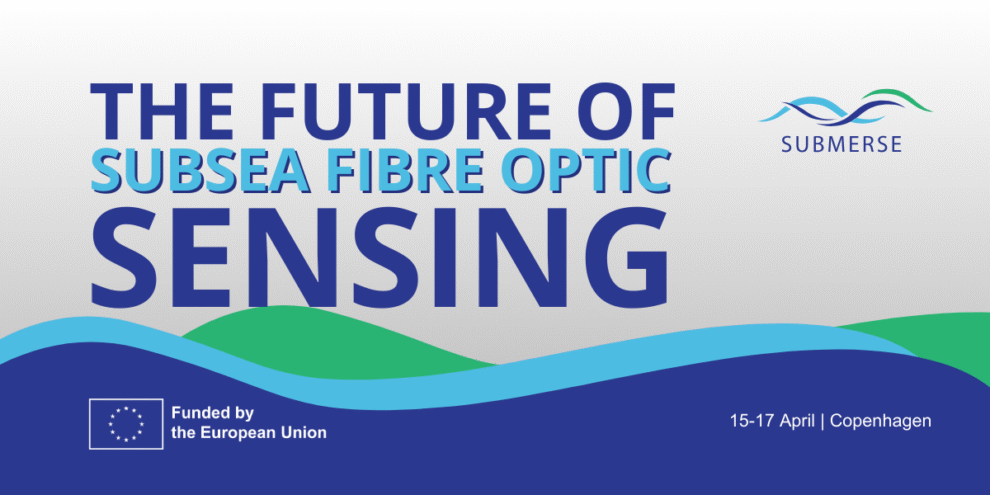
The SUBMERSE Consortium and all its 25 partners are excited to invite you to the SUBMERSE Project Final Event.
Over the past three years, we’ve been working together to explore how Europe’s submarine fibre-optic cables can become scientific tools for seismology, oceanography, and marine biology. Now, as the project enters its final phase, we’re bringing our community together in Copenhagen to share what we’ve learned, reflect on the journey so far, and look ahead to what comes next for fibre sensing in Europe.
Together with our partners from research institutions, industry, and the National Research and Education Networks (NRENs), we’ll explore project results, participate in training sessions, and discuss future research directions.
What to expect
Day 1 – 15 April 2026 – Community Event
The community event will largely focus on scientific applications. We’ll hear an exciting keynote on geoscience and oceanographic use cases and participate in hands-on training sessions to work with fibre-sensing data.
Day 2 – 16 April 2026 – Project Results
This day will be all about sharing what we’ve achieved across Europe. We’ll hear updates from all SUBMERSE fibre-sensing sites in Norway, Portugal, Greece, and Italy, explore our data management strategies, and take time to connect with partners and peers.
Day 3 – 17 April 2026 – Closing
On the final day, we’ll look ahead together. An engaging closing keynote will set the scene, followed by sessions exploring future research directions and opportunities for continued collaboration.
Keynote speakers
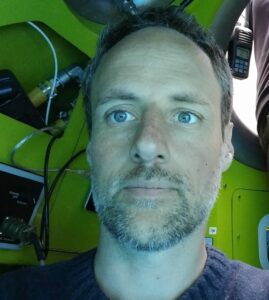 Wired for wonder and warning: Utilising submarine cables for exploration and environmental resilience
Anthony Sladen — Géoazur, France
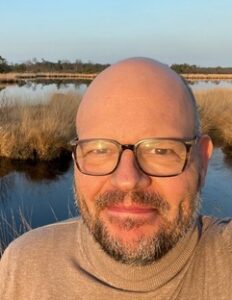
When data changes meaning: Ocean science in a security context
Sander Isendoorn — Netherlands Ministry of Interior and Kingdom Relations
Sander Isendoorn has been active in the security community for over 25 years. For the past 15 years he has had a special interest in internet topology — first from a cyber perspective, and over the last decade increasingly focused on physical infrastructure, particularly submarine telecommunications cables and critical underwater infrastructure. He is currently involved with NATO, ICPC, and ITU working groups on topics including cable resilience and cable sensing.
Outlook on fibre sensing applications
Dr. Angeliki Xenaki — Institute of Applied and Computational Mathematics (IACM-FORTH)
Angeliki Xenaki received her Diploma in Electrical Engineering and Computer Science from the National Technical University of Athens (NTUA), and her M.Sc. and Ph.D. in Acoustics from the Technical University of Denmark (DTU). She has held research positions at Scripps Institution of Oceanography (University of California at San Diego (UCSD)), DTU, GN Hearing A/S (Denmark), and the Centre for Maritime Research and Experimentation (STO-NATO, CMRE, Italy). In 2025, she joined the Foundation for Research and Technology-Hellas as a Principal Scientist, where her research focuses on signal processing, statistical modelling, and machine learning applied to acoustics and sonar imaging.
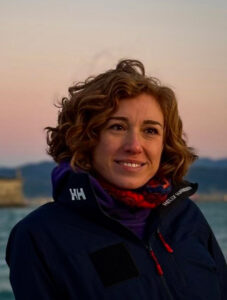
The subsea fibre sensing revolution is here: Where will it take us next?
Giuseppe Marra — The National Physical Laboratory (NPL)
Giuseppe Marra is a Principal Scientist in the Time and Frequency department at the National Physical Laboratory, where he has worked since 2002. His research focuses on optical frequency metrology, including the dissemination of ultra-stable optical frequencies over fibre links and the comparison of optical atomic clocks over intercontinental distances. Over the last several years, he has been pioneering ultra-stable interferometric techniques over terrestrial and submarine cables for the detection of earthquakes and other environmental signals — work that points to new possibilities for monitoring the largely under-sampled ocean floor.
Practical information
Venue
- University of Copenhagen, Faculty of Social Sciences
- Full address: Gammeltoftsgade 15; DK-1355 Copenhagen, Denmark (closest train/metro station: Nørreport Station)
Getting to Copenhagen
Copenhagen is well connected by air, rail, and ferry. Copenhagen Airport (CPH) is around 15 minutes from the city centre by metro. For accommodation and travel tips, Visit Copenhagen website is a good starting point.
Registration
- Format: In-person event (recordings of selected sessions will be shared afterward)
- Capacity: Limited (registration is on a first-come, first-served basis)
- Registration deadline: 25 March 2026
We are looking forward to welcoming you at our final project event. Secure your spot at the link below.