


Beneath the ocean surface, a vast web of fibre-optic cables silently carries 99% of the world’s digital data traffic. For decades, these cables were seen as purely telecommunications infrastructure — invisible enablers of the internet age. The SUBMERSE project changes that story.
SUBMERSE (SUBMarine cablEs for ReSearch and Exploration) spent the past three years demonstrating that these same cables can act as a permanent, real-time sensing and high-resolution monitoring infrastructure, capable of detecting everything from seismic activity thousands of kilometres away to the movements of marine species. Now, as the project approaches its conclusion, the team has published a Policy Brief summarising these findings and setting out a clear set of recommendations for European policymakers.
The technology: turning infrastructure into intelligence
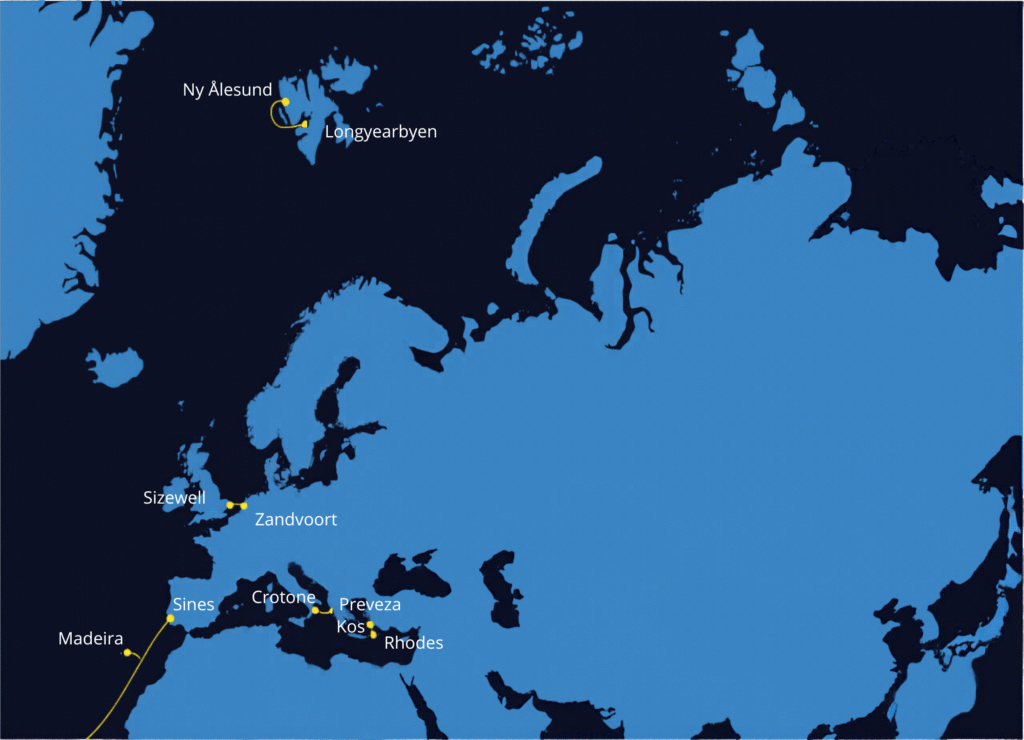
The project deploys four key fibre-sensing technologies across seven pilot sites in five countries — from Svalbard in the Arctic to the Ionian Sea in the Mediterranean, and from Madeira to the coast of the Netherlands.
- Distributed Acoustic Sensing (DAS) uses laser light interferometry to detect physical changes along a fibre-optic cable at intervals as small as every 10 metres, over stretches of up to 120 km. It turns the cable itself into a dense array of environmental sensors.
- State of Polarisation (SOP) monitoring detects physical changes in the environment through variations in the polarisation of light. It works with existing telecommunications equipment, meaning it can be deployed on current and legacy cables without hardware upgrades — enabling detection of seismic activity at massive scale.
- State of Polarisation Optical Time Domain Reflectometer (SOP-OTDR) and Radio Frequency-Optical Time Domain Reflectometry (RF-OTDR) extend these capabilities by enabling fault detection, fibre integrity monitoring, and long-distance sensing across repeater-equipped submarine cables — a significant technical advance for transoceanic monitoring.
Together, these technologies generate high-quality data for a range of scientific applications including oceanography, seismology, volcanology, and marine biology — fields that share a common constraint: the ocean remains largely under-observed.
What the data reveals
At the GeoLab site in Madeira, a 50 km section of the EllaLink cable successfully detected seismic signals from a magnitude 7.8 earthquake in Turkey, over 4,500 km away. The detection was made possible by DAS technology, demonstrating not just sensitivity, but the ability to complement and extend traditional land-based seismometer networks into regions where coverage has historically been sparse or absent.
For tsunami early warning systems, the implications are significant. Detecting the triggering earthquake earlier — and sensing the pressure changes of an approaching tsunami wave directly through the cable — could provide precious additional minutes of warning time for affected coastal regions.
You can read more about this detection on our website: https://submerse.eu/long-range-seismic-activity-detected-using-das-technology-installed-on-madeira-island/
In oceanography, continuous data from fibre-optic sensing enables a shift from episodic, localised measurements to basin-scale observation — directly relevant for climate science, where understanding ocean dynamics is critical for modelling sea level rise and extreme weather events. In marine biology, the same infrastructure can detect biological and ecological signals, opening new pathways for biodiversity monitoring and evidence-based marine management.
How SUBMERSE contributes to addressing policy gaps
The scientific case for subsea fibre sensing is compelling, and the SUBMERSE project provides clear evidence for that. But challenges remain at the policy and governance levels.
The Policy Brief identifies three interconnected challenges:
Security and resilience have become acute concerns following sabotages affecting undersea infrastructure, including the Nord Stream pipelines in 2022 and incidents in the Red and Baltic Seas in 2024. The European Commission’s EU Action Plan on Cable Security, adopted in early 2025, acknowledges these risks and aims to strengthen the resilience of submarine data and power cable infrastructures. SUBMERSE has contributed to this agenda with a White Paper advocating for a Trusted Research Environment approach — advancing fibre-optic sensing technology as a versatile tool for monitoring critical underwater assets and providing surveillance capabilities for maritime and defence agencies.
Data governance remains a core challenge. Significant progress has been made over the past two decades in moving away from institutionally confined datasets toward more open, interoperable and distributed systems — but data fragmentation and standardisation challenges persist. SUBMERSE contributes to tackling this by separating sensitive raw data from shareable scientific outputs, and channelling FAIR-compliant datasets into European platforms including EIDA, EPOS, EMODnet, and the Copernicus Marine Service.
At the policy level, governance of submarine cables remains fragmented across multiple domains, creating a persistent gap between the volume of data collected and the volume that can be accessed and reused for broader societal benefit. SUBMERSE helps close this gap through a coordinated framework that harmonises data governance across countries while respecting national sensitivities and enabling cross-border scientific collaboration.
Recommendations: what needs to happen next
The SUBMERSE Policy Brief sets out four concrete recommendations for EU policymakers and research infrastructure stakeholders:
- Align emerging technologies with established European Research Infrastructures — including EPOS, EMSO, and the ENVRI community — to ensure interoperability, avoid duplication of effort, and support the long-term sustainability of sensing networks.
- Establish EU-level guidelines for managing sensitive subsea data, providing a common framework that balances open science principles with legitimate security requirements.
- Recognise submarine cables explicitly as both research assets and critical infrastructure, integrating sensing capabilities into European resilience and security policies.
- Improve integration between data platforms, high-performance computing, and the EU’s digital initiatives — including the Digital Twin Ocean and the European Open Science Cloud — to fully exploit the scale and continuity of data that this infrastructure can generate.
A timely moment
SUBMERSE concludes in April 2026, but its three years of work have demonstrated something durable: that existing submarine cable infrastructure can serve as a permanent, long-term platform for environmental and geohazard observation, delivering high-quality, standardised, and secure scientific data across multiple disciplines. Realising its full potential now depends on coordinated policy action, stronger governance frameworks, and deeper integration across the European research infrastructure landscape — precisely what the Policy Brief calls for.
Read the full Policy Brief on Zenodo: https://zenodo.org/records/19684139
SUBMERSE (SUBMarinecablEs for ReSearch and Exploration) is a Horizon Europe project funded under HORIZON-INFRA-2022-TECH-01-01. The project ran from May 2023 to April 2026 with a budget of €9,744,100.